If you’re one of those people who thinks executive dysfunction only happens for things we don’t like (school, cleaning,) then please consider the fact that I’ve been meaning to plug my phone in for 20 minutes and I’m now at 2% and still putting it off to write this post ¯_(ツ)_/¯
My anime/video game list consists of over 100 titles, easily, and yet I almost never get around to watching/playing any of them.
Executive dysfunction is not just for boring or unenjoyable things. It’s for everything. Even eating.
What is executive dysfunction? O.o
Put simply, it’s difficulty/inability with initiating tasks. The prefrontal cortex is responsible for executive functions, like decision-making and impulse control. People with ADHD and other neurological disorders that affect the prefrontal cortex often experience difficulty making decisions and performing tasks, as well as exercising self restraint. Part of why people with ADHD tend to procrastinate so badly is out of genuine inability to begin tasks, even if they’re very important.
It feels, for me at least, like I’m constantly waiting for something and I can’t start X task because I’m waiting. I never know what exactly I’m waiting for, but that doesn’t stop me from wasting hours and days not doing the things I need to do, even if I have a desire to do them.
adhd culture is rewinding something because you stopped paying attention and missed a bit, then forgetting to pay attention to the bit you missed and having to rewind it again, then forgetting to pay attention to the bit you missed and having to rewind it again, then forget-
never getting past the first episode of a tv show is adhd culture
hearing about a show and saying “I’ll watch that soon!” and then literally never watching it is adhd culture
Having over over 200 shows on your Netflix list that you keep telling yourself you’ll get around to watching eventually but knowing you won’t even as you add more to the list is adhd culture
executive dysfunction is telling yourself for two and a half hours that you need to shower bc you smell like your workplace and you absolutely Cannot do Anything Else until you shower, doing Any Other Thing before showering is illegal!!! but you still haven’t for some reason??? you’ve just been sitting on your bed in a towel scrolling tumblr for 2+ hours thinking “I need to shower right now immediately” and growing increasingly frustrated that you are still not clean and you haven’t eaten or done your laundry either
ok actually no I’m reblogging this because a) I am clean now (and I smell amazing, thank you), and b) I had a heckin Realize and I wanted to share it with y’all in the hopes it’ll help someone else with a brain like mine.
I figured something out about myself a long time ago– it’s only just now occurred to me that I was in fact solving a problem caused by executive dysfunction, and I haven’t been implementing this solution lately because my brain went “that’s a relatively new term to me and therefore a Different problem that requires a Different solution”. thanks a lot, brain.
anyway, long long ago, before I knew these fancy schmancy Official words, the problem, as I phrased it to myself, was such:
sometimes I get Stuck. I was doing something, or on my way to doing something, and then… I just. got stuck.
“Stuck” looks like refreshing my feed or dashboard repeatedly. or it looks like staring at a spot on the wall. or chewing my fingernails. or picking at a stubborn sticker. all the while, my brain drifts through various unrelated topics I wouldn’t be able to recall if asked. sometimes I can get Stuck for hours before realizing I am Stuck. sometimes I get so Stuck that I go to bed that way (feeling especially bad for being unproductive) and I have to just reset everything by sleeping.
one day I asked myself, “why is this happening? why am I stuck, right now, at this moment in time?” the answer, as it turns out, was pretty simple: I was trying to make a decision, and I got distracted. I haven’t moved forward because I haven’t answered that one question or made up my mind.
let me rephrase this in terms of executive dysfunction: many people have expressed that it feels like knowing you need to do a thing but not feeling “ready” to do it. many with ADHD may also be familiar with the feeling of needing things to be “just so” before you embark on a task- you need your setup to look a certain way, or you need to set a timer, or have the right music playing, etc.
when I get Stuck it’s often because I got lost somewhere in that setting-up process, and my brain took the opportunity to nyoom off into Distraction Town.
getting myself Unstuck is solved, 95% of the time, by tracing my steps back to the original decision I was trying to make- often something small and inane- and then troubleshooting from there. (out loud! verbal processing is totally punk.)
“what was I trying to do?”
“was I trying to decide between two things?”
(the answer’s usually yes.)
“what were they?”
“okay, let’s decide.
“okay, that’s settled. let’s move on.”
and then I am free as a bird to nyoom in the direction of The Thing I Wanted To Do All Along, in the amazingly disorganized, scattered, yet rapid-fire way that I do many things.
so!!! in the case of my first post, where I hadn’t showered for 2 hours? turns out I had been trying to decide what music to listen to in the shower. (another hack: my chances of getting Stuck while showering decrease by 75% if I have music playing to help me keep track of time.) I couldn’t immediately make up my mind, got lost in thought, got distracted, and drifted. once I stopped and asked- “why am I stuck?”- then I remembered- “oh yeah! I wanted to listen to music”- and then decided- “I want to listen to Daft Punk’s Discovery album”- I was finally heckin able to shower. and also eat, and also throw my clothes in the dryer.
and may I add I only zoned out once, during the slow part of “One More Time.” 😛
I’m not saying this is a foolproof method. sometimes I don’t have a reason for being stuck, and that’s okay! I’m also not saying this is how every adhd brain works. it’s just how my brain works, and I’m sure there’s at least a few who can relate. for those few, I hope this helps!!
a lot of people are reblogging the original post without the update and leaving frustrated comments and that makes me sad! if I can find ways to hack my brain than so can you! executive dysfunction is a real and frustrating challenge, but don’t buy the lie that there’s no way to work with it or around it!!!
!!!!
exceedingly familiar circumstance for me. and great to recognize that hey, you did in fact have a solution, you just didn’t recognize it as such.
if you aren’t stimulated for even a second you’re incredibly bored
boredom is literally painful
it’s worse than death
worse than e v e r y t h i n g
feelin that sweet Rejection Sensitive Dysphoria™ any time you get teased or insulted
when you’re listening to music you always tune it out eventually
not picking up on social cues At All
actually, what are social cues?
can’t regulate attention
not interesting = not worth paying attention to
hyperfocus for hours
“wAIT ITS 4 PM WHAT THE F U C K”
did i forget to eat again
The Thoughts go from point a to point g in less than one (1) fuckin sentence
*someone says a thing* what *person repeats thing* what *person repeats thing again and you still don’t hear them but dont ask what again in case they think ur weird*
or, alternatively
*someone says a thing* what *person starts to repeat said thing; you reply less than a second after they start*
using subtitles all the time so you don’t have to go back twenty times to determine What The Fuck someone said
“sorry i tuned you out for that entire sentence can you repeat that”
needing e x t r e m e l y s p e c i f i c d i r e c t i o n s
EXTREMELY POOR VOLUME CONTROL TBH
tfw that thing u were working on falls apart and u cant redo it bc u already did it and that would be boring
long blocks of text are Extremely Hard to Read
ur fuckin brain works 12 times as fast as everyone elses. for every ADHD person it’s somethin different. for me it’s puns. ill choke on my own laughter at a pun an Entire Second before anyone else even gets it
RAMBLING
The Leg Bounce™
Disassociation
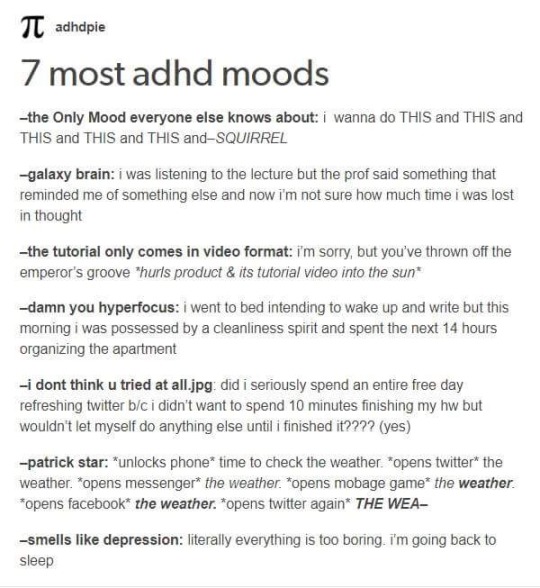
that ADHD feel when you
^^ that one is a True Marker of an ADHD person. only ADHD people understand.
Reblogging because I think this is super helpful
!!!!! PSA that the hyperactive stuff on here (always needing to Do Something, ccaann’‘tt bbee bboorreed, etc) can wind up masked almost totally by maladaptive daydreaming, which, when you think about it, is actually a marvelous way to begin INSTANTLY doing something interesting without even having to get up and go somewhere else. Once you internalize your need for stimulation and start watchin’ the ol’ headmovies, you might LOOK like a very patient person who has no trouble sitting still when it’s required or staying on-task for extended periods of time despite setbacks and delays, but only from the outside. Inside there are tabs open with music videos and etc. playing, and you’re probably glancing back at reality only when necessary. You might look at sensation-seeking symptoms like hyperactivity and think “can’t relate” when, really, you’re just ready to return to your interior hyperactivity at a moment’s notice.
@ everybody who can’t just slip out of reality when boredom threatens and who has to instead find something to entertain themselves with irl, my heart goes out to you and everyone around you because holy fuck
I wonder how many writers and other creatives are ADHD. I mean, that whole “Occupy the brain with invented narratives, characters, dialogue, and wotld-building” thing was my refuge as a child, and has become my happy place as an adult.
I’d write all day, every day, if I could arrange my life for that. Coping technique turned profession. Unfortunately, the Day Jobbe sucks up most of my creative energy, alas.
Others out there like me?
I had a teacher in high school who pulled me aside one day and thanked me for being so attentive in class, and all I could think was, “bitch I am on year three of a Harry Potter OC fanfic, I have not heard a single word you’ve said in weeks.” So, yeah, maybe.
(A couple years ago I turned up positive on an ADHD screening, but I wasn’t jittery and I don’t forget appointments so my therapist said nah, probably not. But I’m finally getting my anemia treated, and I’m starting to wonder if maybe ADHD comorbid with depression and iron deficiency, compensated for by years of refining my note-taking and planner systems, doesn’t explain an awful lot.)
Just so you know, ADHD and ADD are no longer separate diagnoses- there’s just ADHD, and subtypes (primarily inattentive, primarily hyperactive, combined). That means there’s tons of us ADHD people who aren’t hyper physically and may even struggle with fatigue and brain fog pretty badly.
Some more exciting ADHD things include:
– I have lost this thing. When did I lose it? Where did I lose it? Did I ever have it in the first place?
– ‘I’m calling because you missed yo-’ FUCK
– the overwhelming need to be stimulated combined with getting tired of everything quickly and lacking physical energy/ the ability to concentrate
– saying offensive or inappropriate things and then when people are like ‘what are you thinking?’ being like ‘i honestly could not tell you’
– your brain is like one of those shopfront windows with all the TVs playing different channels. at least one of them is a song.
– ‘okay you can’t leave the exam hall until 1PM, so if you finish early you’ll just have to sit there’ haha death would be kinder
– poor emotional regulation. feelings are Very Hard To Handle By Yourself and you might break things when angry, hurt yourself when sad etc
– step one: join club or society. step two: learn everything there is and volunteer for as much responsibility as possible. step three: lose interest completely and ghost or quit, ignoring desperate/confused emails and hating yourself
– “something i thought has distressed me, but i can’t remember what. let me sit down and unpack the last five minutes of mental conversation.”
“!!!!! PSA that the hyperactive stuff on here (always needing to Do Something, ccaann’‘tt bbee bboorreed, etc) can wind up masked almost totally by maladaptive daydreaming, which, when you think about it, is actually a marvelous way to begin INSTANTLY doing something interesting without even having to get up and go somewhere else. Once you internalize your need for stimulation and start watchin’ the ol’ headmovies, you might LOOK like a very patient person who has no trouble sitting still when it’s required or staying on-task for extended periods of time despite setbacks and delays, but only from the outside.“
HAHAHAHAH omg I should have seen this 15 years ago
ADHD is reading the first post in this thread, skipping all the commentary, and rebloggingbit anyway
My input is ADHD is TALKING CONSTANTLY AND UNABLE TO STOP
As someone who’s been maladaptive daydreaming since I was 3/as long as I can remember
It is EXACTLY why I write/draw/get so passionate about stories
But it’s also why as a kid no one saw blatant ADHD- I can be patient and calm but my mind is constantly on high speed daydreaming and creating and writing and it can still be very hard to focus/cope with mental exhaustion
Also I think sometimes your ADHD reacts in weird ways with other mental illness. Like I started taking Adderall and it helped a TON, just being able to get on a task and stay on it a bit better… and then I also started taking mood stabilizers (it turns out my depression is the bipolar kind) and those helped a ton in other ways, but suddenly my ADHD was like HI REMEMBER ME and now I’ve suddenly got energy to Do The Things, but the ADHD is making me Do The Things all at once, so I’ll spend like five seconds on something and then be like “no shit I need to do this other thing before I can do that thing,” and many hours later I’ve done like 5 minutes of 50 different tasks and maybe actually finished a few of them, somehow. I just talked to my meds management person about this the other day, and she’s SUPER HELPFUL but her response was basically like yeah, it can be kind of impossible to tell sometimes what’s a symptom of what, when you’ve got more than one thing going on and more than one type of psych meds to take.
Do I have any followers with ADHD? Or does anyone have some really good information on it? I want to write a character who has ADHD but I don’t know anything about it except the basics so I’m looking to educate myself. Any help beyond a wiki article would appreciated!
Friends, what would you like to see in an ADHD character?
One thing I gleefully identify with is the level of restless frustration experienced by BBC’s Sherlock during boredom (not that Sherlock is necessarily ADHD – let’s not open that diagnostic nightmare of a discussion please!).
I would like to see more of a struggle with internal noise shown in media. Often I see the bouncy, silly outsider view of the disorder and I would greatly appreciate seeing a wider range of symptoms/experiences, including the ones that make us want to pull out our hair. For me, off medication, being in a room where I am required to be silent, still, and focusing is basically my own personal hell.
It doesn’t at all need to be all doom and gloom, just not squirrel-chasing-8-year-old-boy-stereotype so much please!
First of all, philosophium, thanks for asking!
I’m glad ADHD community replied, because they’re a good source of facts about ADHD presented from an ADHD perspective. So, you learn some of what you’d get in a psych textbook, but also what it feels like from the inside.
If you’re really starting from zero, this Buzzfeed article is a nice place to start.
Here’s some miscellaneous information about ADHD that will hopefully help you write more accurate, and less stereotypical, characters.
1) We’re Not All Extraverted, Hyper, Happy Go Lucky Males. We can be male or female, child or adult. I’d love to see an introverted, non-hyperactive ADHD character, ideally a male one. Or an ADHD character who obsessively overthinks, and is prone to anxiety and perfectionism.
2) Look at Both Extremes. In real life, some people with ADHD can only multitask while others can only hyperfocus. Some people with ADHD can focus on the details while ignoring the big picture, others see the big picture brilliantly but miss all the details, while others can bounce back and forth but can’t see both at the same time. Some of us are laid back and prefer to go with the flow, while others react to their disabilities by becoming extremely perfectionistic and trying to plan everything ahead of time (me). Some of us have IQ in the gifted range (see “need for stimulation”), while others have low IQ or severe developmental delays (children who are born prematurely, have lead poisoning, or who have fetal alcohol syndrome often have ADHD). Almost all the people I know with ADHD are artists, scientists, or both.
3) ADHD Is a Disability of Executive Function. Executive function is a confusing mess of tasks performed by the frontal lobe that allow us to control our behavior and respond flexibly and optimally to a changing environment. Some executive functions include working memory, inhibition (i.e., stopping oneself from doing or thinking something), task switching, sustained attention, planning,decision making,prioritizing, prospective memory.
4) We Can Pay Attention, We Just Can’t Regulate It. We can focus for hours on something that interests us, or on procrastinating. We’re not good at focusing on things that we find boring or that don’t matter to us. We also aren’t good at controlling the amount of attention we pay. This is how our attention works:
5) ADHD is a Production Problem, Not a Learning Problem. A lot of us excel at getting information into our brains, especially when it interests us. The difficulty is producing something that shows what we’ve learned by a deadline–be it a paper, a presentation, or a project. For some of us, the hardest part of any assignment is finishing it and turning it in on time in the correct format. If we can do these things, we’ll probably get an A; if we can’t, we’ll probably fail. As a result, the idea of “gradating your effort” doesn’t apply well to us (telling us to “stop being so perfectionistic and do the minimum” makes no sense to us), and our achievement can be all-or-nothing.
6) We Don’t All Get Bad Grades, Or Misbehave in School. Those of us who are smart, learn easily, and are interested in school can get good grades until the demands for organized, well-formatted, and on-time work overwhelm our abilities to produce (see #5). Those with inattentive ADHD, when bored, tend to daydream, look out the window, or draw rather than misbehave. Teachers might not notice these students at all–or might even see them as well-behaved and a joy to teach.
7) Need for Stimulation. As ADHD community said, an ADHD character who is wildly intelligent, and when bored, feels as if they’re in a sensory deprivation tank. Boredom is Chinese water torture. Each second is a drop of water. How we react to this varies. Some are constantly bored and highly aware of their search for stimulation. Others, like me, think they’re never bored because they’ve become very good at keeping themselves occupied. I always carried a book to read and a sketchbook to draw in with me, and I would read even while crossing the street. Only when I needed to learn to cook did I realize I can get bored within literally 10 seconds.
9) Memory Problems. I’d like to see an ADHD character who has a terrible memory, and struggles with the psychological/identity consequences of that and not just the academic ones. They’re constantly writing things down, and constantly worrying about how to organize the record of their life, or about what would happen if it were destroyed in a fire/flood/other accident. The most impaired form of memory, though, is prospective memory, the ability to remember what you are going to do. Memory problems are some of my worst ADHD traits, yet I rarely see them discussed.
10) Paradoxes of Reminders and Clutters. Because of our memory problems, you might think the answer is simple: just put post-it notes everywhere. And indeed, even other ADHD-ers often advise us to use colorful post-it notes and put them everywhere. However, visual clutter shuts our brains off, so we stop looking at these post it notes and reminders–or even look right at them and don’t register their existence. Another version: if items aren’t visible, I forget that they exist. (For example, I forget about food in the back of the refrigerator until it goes bad; I forget about clothes in the corner of the closet). But if too many things are visible, I stop being able to see them. They just look like clutter, an undifferentiated “bunch of stuff” to me. It would seem like the answer is to get rid of as much stuff as possible, but the decisions involved take hours and leave me exhausted.
11) The Paradox of Routines/Habits: Habits help us function despite our inability to remember what we’re supposed to be doing and our tendency to get sidetracked in the middle. That’s because habits require no thought, attention, or memory–we do them automatically.
The problem is, it’s almost impossible for us to make the habit in the first place because we can’t consistently remember to do it. So, you get people with ADHD who forget to take their medication for the very reasons they need it in the first place.
12) Inconsistency. An ADHD character whose functioning is inconsistent from day to day and so feels he/she can’t rely on him/herself. There’s a lot of research on this “intra-individual variability” and indeed, it ranks among the most consistently-found traits found in both children and adults.
13) When we’re exhausted or overwhelmed, or a life crisis happens, we can stop being able to do basic things we used to be able to do. Maybe we used to be able to get to work/school on time, remember when assignments were due, or have a consistent morning routine. Now we’re no longer able to get out of the house on time, remember our assignments, or remember to take our medicine or brush our teeth in the morning. When this happens to me, I realize how much energy and attention I’m putting into doing “basic” things and wonder when I’ll ever “get them under control” so I can focus on learning new things.
14) Slow or Inconsistent Processing Speed. We don’t always talk fast and display high energy (I wish!). Some of us struggle with fatigue and slow processing speed (see: Sluggish Cognitive Tempo, a proposed subtype of Inattentive ADHD). For example, I usually feel mentally and emotionally tired–I feel after a full night’s sleep the way most people do after three or four hours of sleep. The more tired I feel, the more difficulty I have concentrating, multitasking, remembering to do things, and making decisions. This is one reason why stimulants and even wakefulness medications can help. Some people, like me, have inconsistent processing speed. Sometimes I think and talk so fast it irritates others, I find what’s happening around us boring (think of the world’s longest meeting), and I interrupt others. Other times, I am just about to answer someone’s question when they irritably repeat themselves or ask why I’m taking so long to answer. It feels like I’m thinking and talking at the normal speed, but others’ reactions make clear that we’re going much faster or slower than they are. Our relative strengths and weaknesses can affect when we think faster vs. slower than normal. For example, I finished the verbal portion of the SAT and checked my answers multiple times halfway through the time limit. I then had to sit there, bored, until the time was up. On the other hand, I ran out of time on the math section before I could check my work.
15) Some of us are socially awkward penguins, not graceful adrenaline junkies. There’s a stereotype that we’re adrenaline junkies who perform surgeries and jump out of planes. Or, we’re social butterflies who compensate for our school difficulties by playing class clown or making friends with everyone. But some of us are physically or socially awkward. Socially, lapses in attention can make us say things that come off as awkward or rude. Our poor sense of timing and inconsistent processing speed can throw off our conversational rhythm, making us interrupt–or just appear odd. Many of us also have motor coordination delays and difficulties (and research bears this out). As kids, we might have had difficulty using scissors, writing, tying our shoes, throwing or catching a ball, or riding a bike. We can have social and/or motor difficulties without meeting criteria for autism spectrum disorder. (Although a lot of people with ADHD have autism, too–see below).
16) Anxiety. Most of us develop anxiety, for all sorts of reasons. We’re prone to overthinking, to begin with. We have to worry about others misunderstanding us and calling us lazy, stupid, flaky, or rude. Some of us develop an exhausting habit of “constant vigilance” because we know of no other way to avoid making ADHD mistakes (losing things, forgetting things, math/writing errors, running late, etc.).
17) Co-occurring conditions. ADHD rarely rides alone. People with ADHD often have dyslexia, math disability, sensory processing disorder, dyspraxia, autism spectrum disorder, depression, anxiety, bipolar disorder, or allergies. Immune system or digestive problems might make us even more inconsistent.
18) Our family members are likely to have ADHD or autism–diagnosed or otherwise. Many people report being diagnosed with ADHD after their own children were diagnosed. Like autism, dyslexia, and other disabilities, ADHD is highly heritable, meaning that it’s highly likely that someone with ADHD traits will have children with the same traits (and their parents probably have them, too). I have a younger brother on the spectrum, and have met a number of other older ADHD sisters with younger autistic brothers. While the gender thing may be a fluke, I have read that ADHD and autism share genetic causes and can run together in families.
19) We have a variety of attitudes towards our ADHD. Some of us see ADHD as uniformly disabling, preventing us from using our talents and passions Other people see ADHD as a gift. People with each of these viewpoints sometimes see the opposite as harmful to people with ADHD. Still others view ADHD as a trait like any other, which can have positive or negative effects depending on how one chooses to use it and what environment one is in. (Personally, I see ADHD, in general, as a set of traits. However, I see mine as mostly negative because they have been impairing me recently and preventing me from pursuing a longstanding dream. I view my ADHD traits as preventing me from using many of my talents and passions. However, there are environments where they’d be less disabling, and I’m currently trying to find them).
20) Being diagnosed and labeled can have good effects, too. There’s a sense of relief, of understanding, of not being broken, of having words for one’s experience. The book title “You mean I’m not lazy, stupid, or crazy?” captures the feeling pretty well, I think. I’ve also written about the benefits of diagnosis and the crappiness of growing up without diagnosis a LOT–see this, this, most of all, this:
“…that sense that there was some mysterious thing wrong with me. (Do you know what it feels like, to carry around a sense that something is wrong with you, always ready to erupt, and not know what’s wrong or why? To have people constantly pointing out when you do something wrong but never acknowledging that mysterious brokenness–pointing out the elephant dung and squished sofa in your living room but never mentioning the elephant or offering to help get it out of your living room? And since no one will talk about the elephant, you have no idea how to get it out of your living room, so you’re just stuck with it there. No one can tell you how to fix what’s broken).”
21) Stimulants don’t necessarily turn you into a zombie. They aren’t necessarily a cure-all, either, and some of us choose not to take them. I have yet to find a medication at a dose I can take daily, because it makes me completely lose my appetite. I only take it during emergencies–high-stakes days where I’m not able to function, and/or due to other health problems acting up, I can’t drink coffee. This isn’t the only side effect. Some people get migraines from stimulants. These medications can also slightly stunt children’s growth.
22) ADHD can be seriously disabling. ADHD looks on the surface like something “everyone deals with,” but as the experiences I’ve described above suggest, it can cause serious problems in school, work, and relationships. The large-scale MTA study, which followed hundreds of girls and boys with ADHD into adulthood, found some poor outcomes, including higher rates of self-injury and mental illness; adolescent substance use; eating disorders; and poorer relationships with peers in adolescence and parents and partners in adulthood. ADHD has also been linked to lower test performance, poorer education and work performance, greater risk of accidents, and obesity. Researchers and the media tend to describe these problems as a result of the ADHD traits themselves, especially impulsivity. But the way we treat people with ADHD probably has a lot to do with the bad outcomes. One contributing factor: many, especially those diagnosed late in life, develop crippling shame and self-hatred.
23) We’re also awesome! People with ADHD can be creative, energetic, passionate, thoughtful, academically skilled, empathetic, entrepreneurial, and more. Famous people in every walk of life have diagnosed ADHD, and many past geniuses have traits. Like other disabilities, ADHD colors how we experience and act in the world, but it does not diminish us or make us less human.
24) Bonus point that doesn’t fit anywhere: I’ve noticed that smart women with ADHD have a very distinctive style of talking. We talk fast, crowding as many ideas into a sentence as possible before we forget what we’re saying. We are trying to pack a lot complicated thoughts into a short amount of time. We veer off on tangents whenever someone says something interesting. If two of us start talking, we can go on for hours and never run out of things to say–and also never return to the topic we started with. To those who do not have ADHD, we sound rambling or incoherent. To other women with ADHD, we make perfect sense and the conversation feels exhilarating, with the energy building increasingly as we talk. We sound incoherent to others but not each other because our thoughts are arranged in a very dense and logical web, but we move through the web in a zig-zagging pattern based on associations instead of a straight line. The zig-zag pattern happens in part because with our short working memory, our span of awareness is extremely short. So we operate on associations; everything reminds us of something else. Other people’s words, objects in the room, and music we hear reminds us of something, but then then we forget what we were talking about before. We’re constantly forgetting what we were talking about or what we were doing in the middle. As a result, some of us have a bad habit of interrupting others in order to get our message out before we forget it.
If you have any more questions, feel free to ask! Sorry this was so long…
I… uh… didn’t actually realize that I got bored until I read this post O_O I thought I was just getting worse at entertaining myself. But that makes total sense – it’s actually because I’m paying more attention to reality and ten seconds isn’t long enough to zone out but it’s long enough to get bored.
are you ready for the latest in research-based [ingroup] demographic stereotypy? this one’s a doozy.
In our clinical practice, adults with IQ scores in and above the superior range have sought evaluation and treatment for chronic difficulties with organizing their work, excessive procrastination, inconsistent effort, excessive forgetfulness, and lack of adequate focus for school and/or employment. They question whether they might have an attention deficit disorder, but often they have been told by educators and clinicians that their superior intelligence precludes their having ADHD.
Typically, these very bright individuals report that they are able to work very effectively on certain tasks in which they have strong personal interest or intense fear of immediate negative consequences if they do not complete the task at once. Yet they are chronically unable to make themselves do many tasks of daily life they recognize as important but do not see as personally interesting at that moment. When provided treatment appropriate for ADHD, these very bright individuals often report significant improvement in their ability to work effectively while their medication is active.
yes. so. how would you like a summary of my educational career?
Clinical interviews with patients in this study indicated that individuals with high IQ who have ADHD may be at increased risk of having recognition and treatment of their ADHD symptoms delayed until relatively late in their educational careers because teachers and parents tend to blame the student’s disappointing academic performance on boredom or laziness, especially as they notice the situational variability of their ADHD symptoms.
Like most others with ADHD, these individuals have a few specific domains in which they have always been able to focus very well, for example, sports, computer games, artistic or musical pursuits, reading self-elected materials. Parents and teachers tend to assume that these very bright persons could focus on any other tasks equally well, if only they chose to do so. These observers do not understand that although ADHD appears to be a problem of insufficient willpower, it is not (Brown, 2005).
Many also reported that they often demonstrated considerable prowess in performing specific tasks in which they had little positive personal interest but did experience considerable fear of immediate negative consequences if they did not complete that particular task by some external deadline. Often subjects described this as a character trait, “I’m just a severe procrastinator” or “I always work best under pressure.”
that’s not all.
In an unpublished study of 103 treatment-seeking adults with IQ 120 or more diagnosed with ADHD, Brown and Quinlan (1999) found that 42% had dropped out of postsecondary schooling at least once, although some did eventually return to complete a degree. Those data together with this present study suggest that individuals with high IQ and ADHD, despite their strong cognitive abilities, may be at significant risk of educational disruption or failure due to ADHD-related impairments of EF.
and now?
Biederman et al. (2006) […] found that adults with ADHD who self-reported elevated levels of EF impairments on the CBS tended to be significantly more impaired on measures of global functioning, had more comorbidities, and held lower current socioeconomic status than did those with or without ADHD who scored below the median on that scale. […]
¯_(ツ)_/¯
So, like, I don’t know how many of you-all this stuff describes, but it was awfully familiar to me and what my life has been like, so I wanted to share it since it’s an actual freaking pattern for us ADHDers who are also “gifted.”
-J
Never have I seen a single study that so perfectly sums up my life. The part where my fellows in executive dysfunction saw a lot of improvement on ADHD medication would be totally awesome if I had health care or the free clinics were even allowed to prescribe said medication! Hahaha, there’s that lower socioeconomic status keeping me in the gutter again, that rascal!
Guess what kind of screening costs $300 and is dubiously uncovered by insurance?





 NineofShades